|
| White clover |
Showing posts with label low water gardening. Show all posts
Showing posts with label low water gardening. Show all posts
Wednesday, August 7, 2013
Clover Lawn


Saturday, May 18, 2013
First Peonies of the Year
 | |
| Tree Peony |
Thursday, May 16, 2013
Summer Garden Re-Runs
 |
| Moss rose seedlings |
For example, I was working in the flower bed out front by the street last evening. Moss rose, or portulaca, was growing there last year, and I know it reseeds. I kept a careful eye out as I pulled out grass and weeds, and sure enough, there were the tiny little seedlings of the moss rose, just starting to grow.
Tuesday, May 7, 2013
Favorite Flowers: Creeping Phlox
 |
| Creeping phlox |
Perennial, zones 3-9
Full sun to light shade, 2-6" tall
One of the flowers that adds so much color to the spring garden is creeping phlox, also known as moss pinks. In the spring, when it blooms, it is literally covered with small flowers for several weeks. When grouped together or allowed to spread as a groundcover, this mass of color is stunning. Creeping phlox blooms in pink, rose, lavendar, blue, white or variegated. Even when the flowering is over, the needle-like foliage, evergreen in milder climates, makes a nice thick ground cover.
Thursday, September 6, 2012
Favorite Flowers: Moss Rose
Allergy Index Scale: 2
Annual
Full sun, 4 - 6 inches
Portulaca, generally called moss rose, is a great low-growing plant for hot, sunny areas. It blooms for much of the summer, with colorful flowers that may be red, orange, pink, yellow, or white, or occasionally variegated. A single plant may spread up to two feet, so they can make a great ground cover. I like to use them in areas that are hard to reach with the garden hose, as they tolerate hot Kansas sun better than most flowers, and with less watering. They do well along that hot drive, in rock gardens, containers or tumbling over the edges of a hanging basket.
Annual
Full sun, 4 - 6 inches
 |
| Multi-colored moss rose |
Portulaca, generally called moss rose, is a great low-growing plant for hot, sunny areas. It blooms for much of the summer, with colorful flowers that may be red, orange, pink, yellow, or white, or occasionally variegated. A single plant may spread up to two feet, so they can make a great ground cover. I like to use them in areas that are hard to reach with the garden hose, as they tolerate hot Kansas sun better than most flowers, and with less watering. They do well along that hot drive, in rock gardens, containers or tumbling over the edges of a hanging basket.
Wednesday, August 15, 2012
Favorite Flowers: Purple Coneflower
 Allergy Index Scale: 5
Perennial, zone 3
Full sun, 2-3 feet tall
One of the perennial flowers that most reliably handles the hot Kansas summers without pampering is the purple coneflower, or echinacea. This native plant can handle the extremes of both winter and summer and keep going.
Originally their flowers were a rosy pink color, but they are also available now in white, yellow, orange, and red. They bloom in the summer and early fall. If you deadhead them during the summer, they will keep blooming for many weeks. Leaving the seedheads at the end of season provides seeds that are attractive to native birds such as goldfinches.
Tuesday, July 24, 2012
Scorched Leaves
Recently I had someone ask about their plants' leaves being scorched by the hot weather. That's an issue I'm dealing with as well, so I started reading up on it. I'd noticed that it seems to happen mostly to plants more recently planted rather than mature ones, so I was not surprised to find out that it is generally an issue with plants that have inadequate root systems. Many times it happens to plants that have not been in the ground long enough to establish a good root system, so in prolonged very hot weather, and with hot winds, the roots are simply unable to supply water to the foliage as fast as it is lost by transpiration from the leaves. Other times it may happen to more mature plants that have not developed good root systems or have had damage to their roots, such as roots dehydrated by too little winter moisture, or stunted by compacted soil or poor drainage. Often the effects of a dry winter are seen in mid-summer when plants struggle with scorched leaves.
Tuesday, June 26, 2012
Gardening in a Heat Wave
 | |
| Moss rose thrives in hot summers |
Heat like this, especially over an extended period, is really hard on the garden (as well as people, animals, utilities budgets, etc.) There are a few things a gardener can do to help their plants make it through this kind of weather.
Subscribe to:
Posts (Atom)
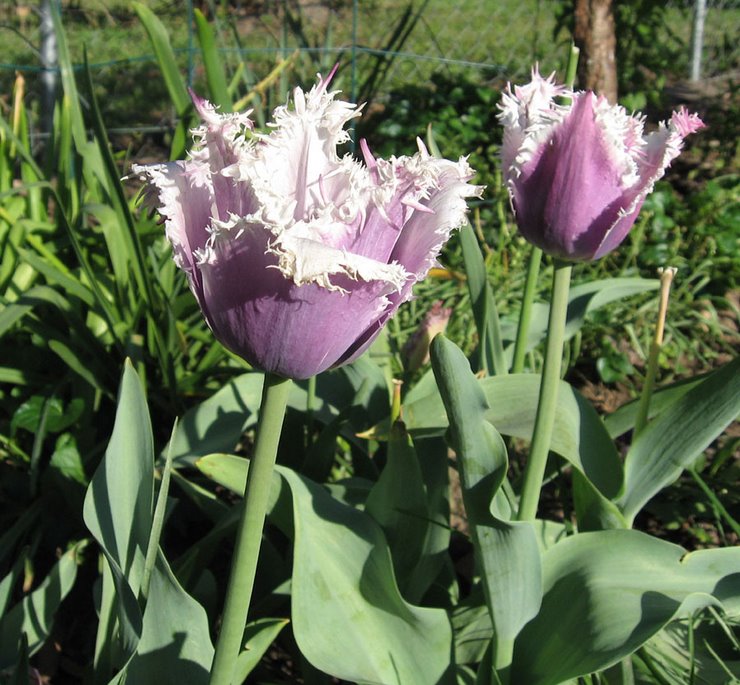
Fringed Tulips